Jul 20, 2026Lighting Knowledge
Lens vs Reflector for LED Track Lights: Which Optical Solution Is Better?
Compare LED track light lenses vs reflectors to understand beam control, light efficiency, glare performance, and applications. Choose the right optical solution for commercial lighting projects.
Introduction
When selecting LED track lights for commercial lighting projects, many lighting designers, architects, and buyers face an important question:
Should you choose LED track lights with lenses or reflectors?
The optical system is one of the most critical components that determines the lighting performance of a track light. It directly affects:
- Beam angle control
- Light distribution
- Glare performance
- Visual comfort
- Lighting efficiency
- Overall atmosphere of the space
Both LED track lights with optical lenses and LED track lights with reflectors are widely used in retail stores, fashion boutiques, museums, hotels, galleries, and commercial spaces.
However, each solution has its own advantages and is suitable for different applications.
This article will compare LED track light lenses vs reflectors and help you choose the right optical solution for your project.
1. Why Optical Design Matters for LED Track Lights?
LED chips naturally produce highly directional light. Without proper secondary optical control, the light output may cause:
- Uneven illumination
- Excessive brightness in the center
- Poor beam control
- High glare
- Uncomfortable visual experience
A professional LED track light requires a well-designed optical system to redistribute LED light efficiently.
The main goals of optical design are:
✔ Precise beam control
✔ Uniform light distribution
✔ Reduced glare
✔ Higher light efficiency
✔ Better visual experience
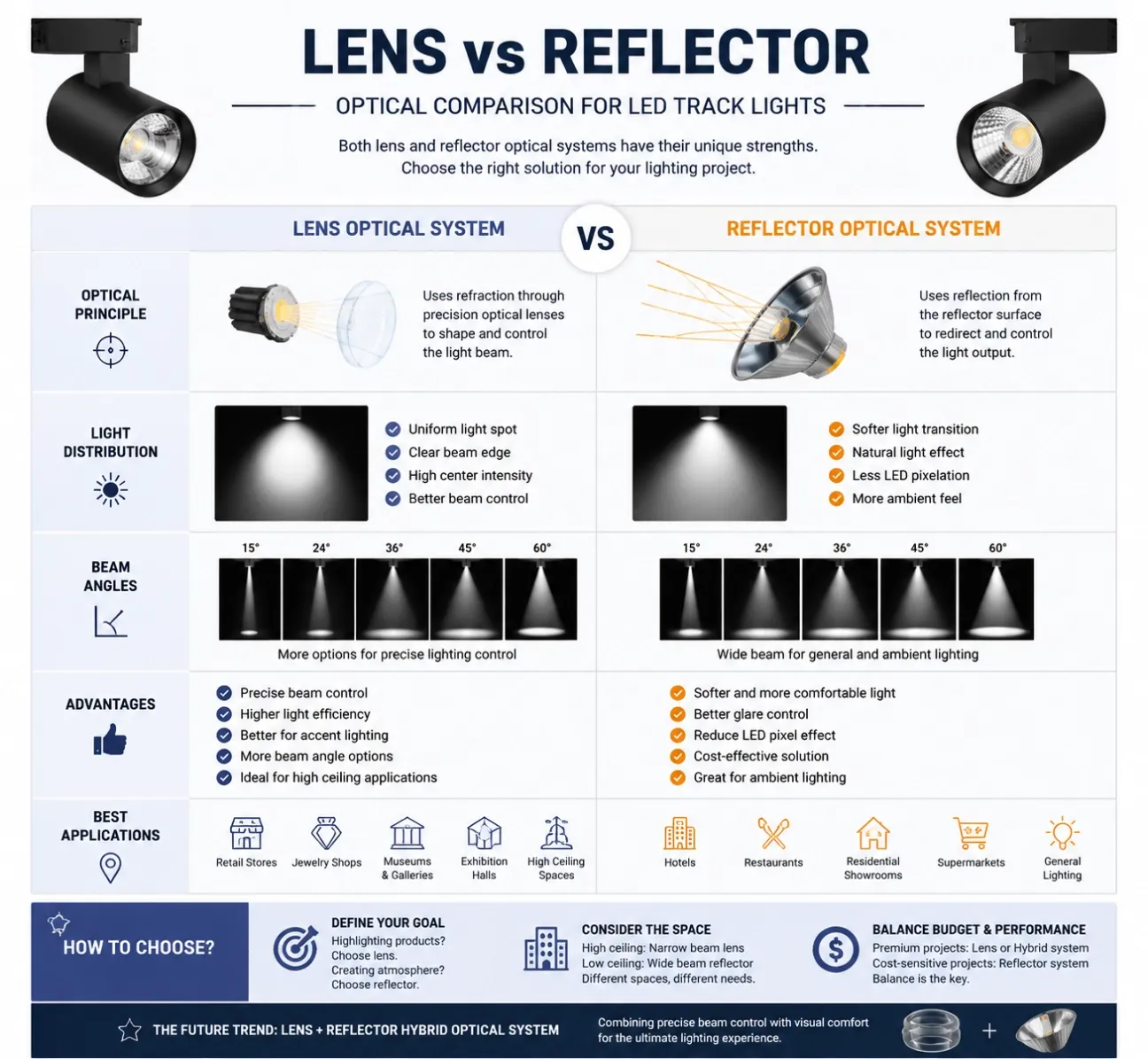
Currently, the two most common optical solutions are:
- Optical Lens System
- Reflector System
2. LED Track Light with Lens: Features and Advantages
What Is an LED Optical Lens?
An optical lens uses the principle of light refraction to control LED light output.
Made from high-transparency materials such as:
- PMMA optical lens
- PC optical lens
- Silicone lens
The lens can precisely shape the light beam into different angles, including:
- 15° Narrow Beam
- 24° Spot Beam
- 36° Medium Beam
- 45° Flood Beam
- 60° Wide Beam
Advantages of Lens Track Lights
1. Precise Beam Control
The biggest advantage of optical lenses is accurate light distribution.
The lens can concentrate light exactly where it is needed, making it ideal for:
- Product highlighting
- Display lighting
- Accent lighting
- Artwork illumination
For example, in a fashion retail store, narrow beam lenses can create focused lighting effects to enhance clothing displays and improve product visibility.
2. Higher Light Efficiency
A high-quality optical lens minimizes light loss and directs more light toward the target area.
Compared with traditional reflector systems, lens-based track lights usually provide:
- Higher center illuminance
- Better beam utilization
- Stronger projection distance
They are especially suitable for:
- High ceiling spaces
- Shopping malls
- Exhibition halls
- Large retail environments
3. Better Beam Uniformity
Professional optical lenses are designed through optical simulation to create:
- Smooth circular light spots
- Clear beam edges
- Uniform brightness distribution
This helps avoid common lighting problems such as:
- Dark rings
- Uneven spots
- Excessive central brightness
Disadvantages of Lens Track Lights
1. Higher Cost
High-performance optical lenses require:
- Precision molds
- Optical engineering
- Premium optical materials
Therefore, lens track lights usually have a higher production cost compared with standard reflector models.
2. Higher Optical Design Requirements
Poor-quality lenses may cause:
- Yellow edges
- Uneven light spots
- Color inconsistency
- Lower optical efficiency
Therefore, the quality of the lens design is extremely important.
3. LED Track Light with Reflector: Features and Advantages
What Is a Reflector System?
A reflector controls LED light through reflection.
The reflector redirects light emitted from the LED source and improves beam concentration.
Common reflector materials include:
- Aluminum reflector
- PC reflector
- Electroplated reflector
Advantages of Reflector Track Lights
1. More Natural and Comfortable Lighting
A well-designed reflector creates a softer light distribution with smoother transitions.
It is commonly used in:
- Luxury retail stores
- Hotels
- Restaurants
- Residential showrooms
where visual comfort and atmosphere are important.
2. Reduced LED Pixel Effect
LED lenses may sometimes create visible LED images or multiple light patterns.
A reflector can improve light mixing and create a softer visual appearance.
This makes reflector track lights suitable for environments where customers stay for longer periods.
3. Cost-Effective Solution
Compared with optical lenses, reflectors usually offer:
- Lower tooling cost
- Easier production
- Better cost control
They are widely used in commercial lighting projects requiring reliable performance and competitive pricing.
Disadvantages of Reflector Track Lights
1. Less Precise Beam Control
Because reflectors rely on light reflection, beam control is generally less accurate compared with professional optical lenses.
Limitations include:
- Less defined beam edges
- Lower projection accuracy
- Reduced long-distance lighting performance
2. Optical Performance Depends on Design Quality
The reflector angle, surface treatment, and material quality directly affect:
- Light efficiency
- Beam uniformity
- Glare control
Low-quality reflectors may create:
- Excessive glare
- Uneven light distribution
- Uncontrolled stray light
4. Lens vs Reflector: Comparison Table
Feature | Optical Lens | Reflector |
|---|---|---|
Beam Control | ★★★★★ | ★★★★ |
Light Efficiency | High | Medium-High |
Beam Accuracy | Excellent | Good |
Light Uniformity | Excellent | Good |
Visual Comfort | Good | Excellent |
Glare Control | Excellent with proper design | Good |
Cost | Higher | Lower |
Accent Lighting | Excellent | Good |
Ambient Lighting | Moderate | Excellent |
Design Flexibility | High | Medium |
5. Which Optical Solution Is Better for Different Applications?
Fashion Retail Lighting
Recommended: Optical Lens Track Light
Fashion stores require:
- Strong product emphasis
- Accurate color presentation
- Attractive visual effects
Recommended beam angles:
- 24°
- 36°
Lens track lights help create professional retail lighting environments.
Jewelry Store Lighting
Recommended: Narrow Beam Lens Track Light
Jewelry requires:
- High contrast
- Focused illumination
- Strong sparkle effect
Recommended beam angles:
- 15°
- 24°
Museum and Gallery Lighting
Recommended: Precision Lens System
Artwork lighting requires:
- Accurate beam positioning
- Controlled light distribution
- Reduced glare
Professional optical lenses provide better control.
Hotel and Restaurant Lighting
Recommended: Reflector Track Light
Hospitality spaces focus more on:
- Comfort
- Warm atmosphere
- Relaxed visual experience
High-quality reflectors create softer and more natural lighting.
6. Future Trend: Hybrid Optical System
In high-end commercial lighting, many manufacturers are developing a combination of:
Optical Lens + Reflector Hybrid System
This design combines the advantages of both technologies:
Inner Lens:
- Controls beam angle
- Improves efficiency
- Provides accurate light distribution
Outer Reflector:
- Reduces glare
- Improves appearance
- Creates a softer visual effect
Benefits:
✔ Precise lighting control
✔ Better visual comfort
✔ Lower glare
✔ Premium product appearance
This hybrid optical design is becoming a popular trend in professional LED track lighting.
7. How to Choose the Right LED Track Light Optical System?
The best choice depends on several factors:
1. Lighting Purpose
For highlighting products:
→ Choose optical lenses
For creating atmosphere:
→ Choose reflectors
2. Installation Height
High ceilings:
→ Narrow beam lens (15°-24°)
Low ceilings:
→ Medium/wide beam reflector (36°-60°)
3. Project Positioning
Premium commercial projects:
→ High-quality lens or hybrid optical system
Cost-sensitive projects:
→ Well-designed reflector system
Conclusion
There is no absolute winner between LED track light lenses and reflectors.
The right optical solution depends on the application, lighting objectives, installation environment, and project requirements.
Optical lens track lights are ideal for precise accent lighting, retail displays, jewelry stores, and exhibition spaces where accurate beam control is essential.
Reflector track lights are better suited for comfortable ambient lighting, hospitality environments, and projects requiring a softer visual experience.
For professional commercial lighting solutions, the best results come from a complete system design that integrates:
- LED chip selection
- Optical design
- Anti-glare structure
- Thermal management
- Lighting application requirements
A well-designed LED track light is not only about brightness — it is about creating the right visual experience.