Jul 14, 2026Buying Guides
Material Selection Guide for Custom Commercial Lighting Fixtures: A Comprehensive Analysis of Die-Cast Aluminum and 6063 Extruded Aluminum
The essence of material selection for commercial lighting is balancing scenario requirements with cost.
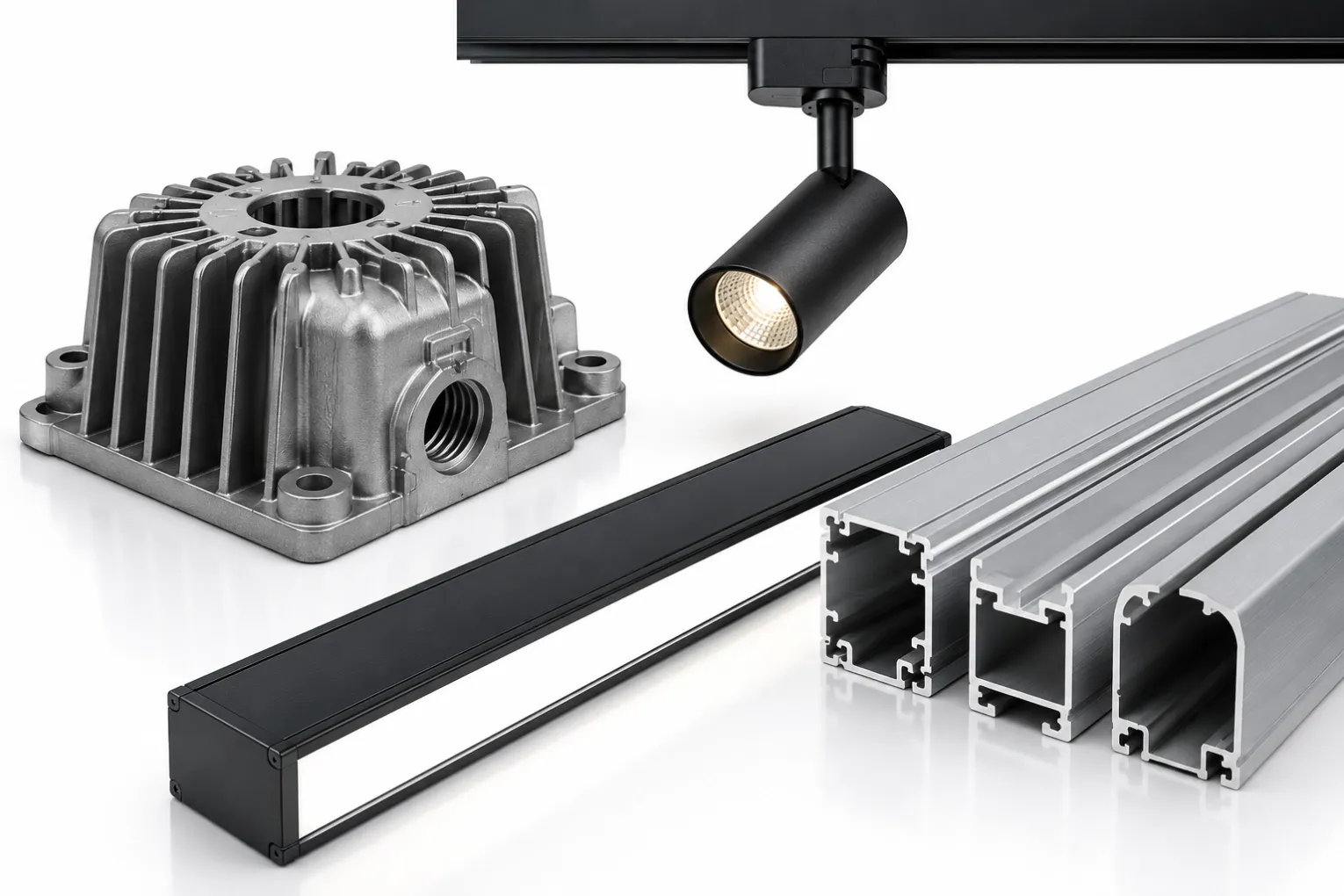
In commercial lighting projects and fixture selection, the material of the lamp body directly determines the lamp's heat dissipation efficiency, lifespan, appearance, and long-term stability. Unlike the short-term on-off usage of household lighting, commercial lighting fixtures operate for 10-16 hours per day on average. Prolonged high-temperature operation easily leads to accelerated light decay, paint aging, and fixture damage. Currently, the mainstream materials for commercial lighting fixtures are divided into two main categories: ADC12 die-cast aluminum and 6063-T5/T6 extruded aluminum profiles. There is no absolute superiority or inferiority between the two; the difference lies only in their suitability for different scenarios. Accurately distinguishing the characteristics of these two aluminum materials is crucial for lighting fixture procurement, project implementation, and product development.
I. Core Material Principles and Basic Characteristics Differences
The core difference between the two aluminum materials stems from the fundamental differences in their forming processes and material structures, which directly determine the differences in heat dissipation, durability, and appearance.
ADC12 die-cast aluminum is formed by casting molten aluminum at high temperatures, allowing for the one-piece molding of complex three-dimensional structures. It features integrated heat dissipation fins, drive chambers, and mounting clips, eliminating the need for extensive secondary processing and resulting in extremely high mass production efficiency. However, the casting process introduces micropores and a loose structure within the material, disrupting heat conduction pathways. Additionally, the material's purity is relatively low, limiting its thermal conductivity, and it cannot undergo high-end anodizing treatment.
6063 extruded aluminum profiles are formed by high-purity aluminum rods through high-temperature extrusion. This results in continuous, dense metal grains without pores, significantly improving thermal conductivity compared to die-cast aluminum. After T5/T6 aging treatment, the material exhibits enhanced stability, allowing for precision machining to achieve thinner cross-sections. It also supports hard anodizing, providing corrosion and weather resistance and a superior aesthetic appearance. The only drawback is its limited forming capability; it can only produce long, uniform cross-section structures, while complex, irregularly shaped structures require subsequent CNC secondary machining and assembly.
II. Comprehensive Comparison of Key Performance Aspects (Core Assessment Dimensions for Commercial Lighting)
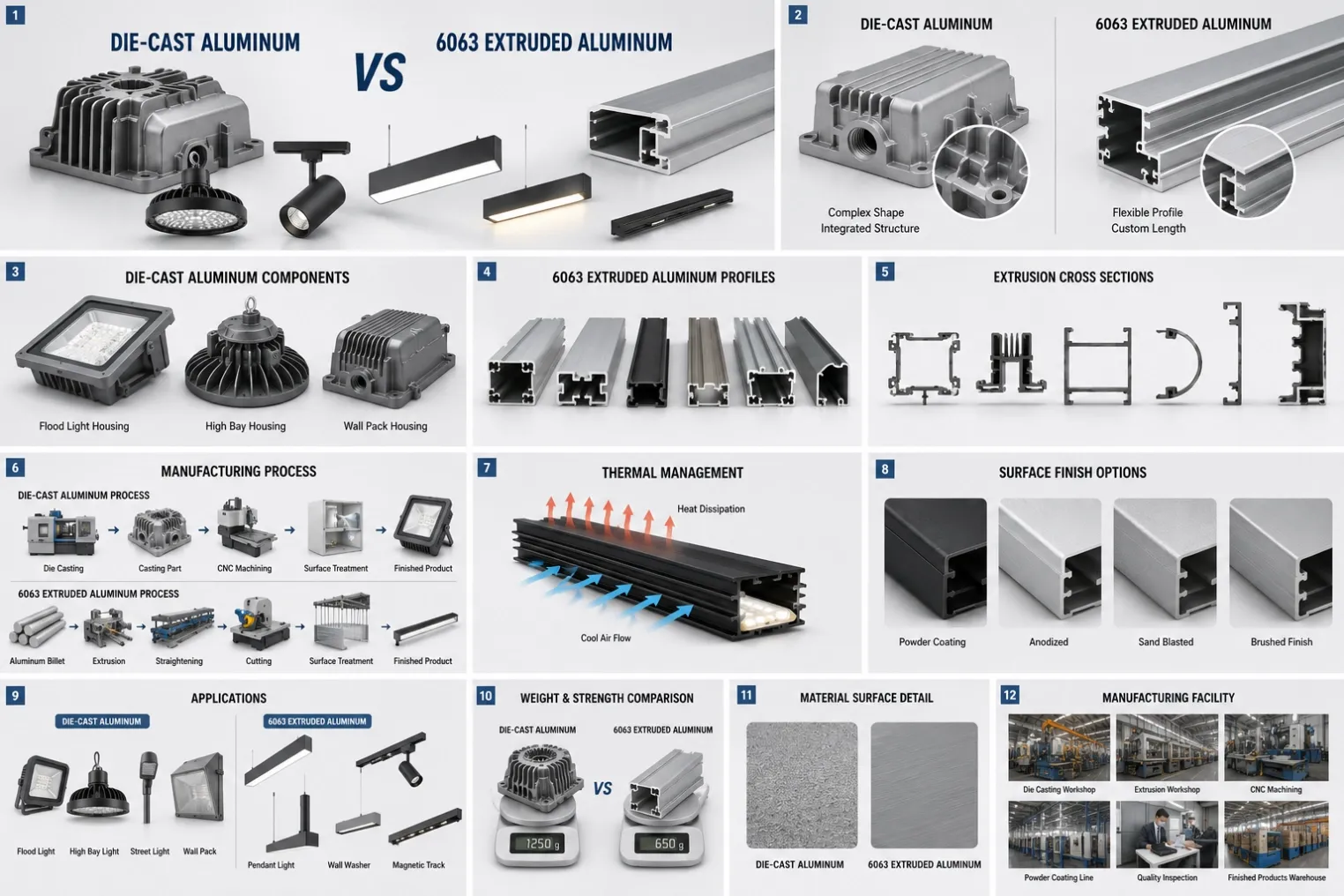
- Heat Dissipation Performance: The Core Determinant of Lamp Lifespan The biggest source of wear and tear on commercial lighting fixtures is long-term high-temperature heat accumulation. Heat dissipation capacity directly controls the rate of light decay and the overall lifespan of the fixture. 6063 extruded aluminum has a thermal conductivity of 180–220 W/m·K, nearly twice that of ADC12 die-cast aluminum (96–120 W/m·K). Its continuous, dense metal structure can quickly dissipate heat from the LED light source, resulting in a lower lamp body temperature rise at the same power, and extremely slow light decay over long-term operation, perfectly meeting the needs of long-term continuous operation in commercial scenarios.
In contrast, die-cast aluminum, due to its internal pores hindering heat conduction, experiences significant heat accumulation. High-power lamps are prone to problems such as color temperature shift, brightness decay, and driver aging after long-term use, only meeting the heat dissipation requirements of basic lighting.
- Appearance and Weather Resistance: Determining the Scene Grade and Long-Term Appearance
6063 extruded aluminum supports high-end processes such as sandblasting, wire drawing, and hard anodizing, resulting in a delicate and uniform surface with a high-end metallic texture, no color difference, and no fading. The anodized layer achieves over 1000 hours of salt spray resistance, offering excellent moisture resistance, rust prevention, and corrosion resistance. It is suitable for complex commercial environments such as fresh food supermarkets, restaurants, and humid coastal areas, maintaining its new-like appearance even after long-term use.
Die-cast aluminum, due to internal porosity defects, cannot undergo hard anodizing and can only be surface-treated with powder coating or painting. Paint adhesion is limited, making it prone to paint chipping from impacts. In humid environments, it is susceptible to blistering, oxidation, and blackening. After 1-2 years of use, it is prone to aging and is only suitable for basic engineering scenarios where appearance and weather resistance requirements are not high.
- Structure and Forming Capabilities: Adaptable to Different Lighting Fixture Shapes The core advantage of die-cast aluminum is its high degree of design freedom. It can be integrally molded into circular, irregular, and multi-layered three-dimensional structures. It features a built-in drive storage compartment, mounting clips, and radial heat dissipation fins, resulting in a robust structure and simple assembly without complex secondary processing. This makes it the preferred choice for three-dimensional lighting fixtures such as circular downlights, conventional spotlights, and industrial/mining lights.
6063 extruded aluminum can only be formed into long strip structures with a uniform cross-section, making it unsuitable for complex three-dimensional shapes. However, it can achieve ultra-thin wall thicknesses of 0.8–1.5mm, offering significant lightweight advantages. Its unlimited cutting capability perfectly adapts to linear lighting fixtures such as magnetic tracks, linear wall washers, shelf lights, and long cabinet lights, resulting in smaller joint gaps and better overall sealing.
- Cost and Mass Production Suitability: Core Considerations for Engineering Procurement Die-cast aluminum molds are expensive, costing 30,000–80,000 RMB per set, with a development cycle of 30–45 days. However, mass production processes are simple, and labor costs are low. In large-volume orders exceeding 50,000 sets per year, the cost per unit is significantly lower, resulting in extremely high cost-effectiveness.
6063 extruded aluminum profiles have mold opening costs of only 5,000–15,000 RMB. They offer flexibility in design modifications and cross-section adjustments, a short development cycle, and are suitable for small-batch, multi-style, and non-standard customized orders. However, they require secondary processing such as cutting, milling, tapping, and adding end caps, leading to higher labor costs and an overall finished product price 15%–30% higher than die-cast aluminum lighting fixtures.
III. Precise Scene Selection: When to Use Die-cast Aluminum? When to Use Extruded Aluminum?
Scenes and Lighting Fixtures Prioritizing ADC12 Die-cast Aluminum
For basic commercial lighting scenarios focusing on high cost-effectiveness, large-volume production, and standardization, die-cast aluminum lighting fixtures are the first choice. Specifically, this includes affordable recessed downlights, standard 8-12W track lights, basic lighting fixtures for supermarkets and convenience stores, and three-dimensional lighting fixtures for industrial and mining high-bay lighting. Suitable for property renovations, mass-produced commercial projects, affordable supermarkets, and basic public area lighting, the core requirements are low cost, easy mass production, and fast delivery, without the need for extreme heat dissipation or high-end aesthetics.
Scenes and fixtures prioritizing 6063 extruded aluminum: For high-end displays, long-lasting durability, complex environments, and customized scenarios, 6063 extruded aluminum lighting fixtures are essential. This includes magnetic track lighting systems, linear wall washer lights, display case shelf lights, and high-power (15W and above) high CRI jewelry/clothing spotlights. Also suitable for high-end hotels, brand stores, medical aesthetics showrooms, art galleries, fresh food restaurants, and coastal commercial spaces. These scenarios have extremely high requirements for lighting stability, product display quality, fixture lifespan, and aesthetic appearance; the heat dissipation, weather resistance, and aesthetic advantages of extruded aluminum can be maximized.
IV. Industry Selection Summary and Procurement Guidelines The essence of material selection for commercial lighting is balancing scenario requirements and cost. There's no need to blindly pursue high-end materials, nor should one prioritize low prices while ignoring potential quality risks.
Finally, here are some industry-standard selection guidelines for quick decision-making: For common round lights, high-volume production, and stable, low-cost options, choose die-cast aluminum; for linear, long strip lights, high-end displays, humid environments, and long-term illumination, choose 6063 extruded aluminum.
For commercial lighting professionals, accurately understanding the compatibility boundaries between the two aluminum materials is crucial for controlling project costs, avoiding over-investment, and preventing problems like rapid light decay, easy aging, and numerous after-sales issues caused by material mismatch. This is the core foundation for creating effective commercial lighting solutions and improving project quality.