Jul 25, 2026Buying Guides
How ELYCEN LED Lighting Products Meet European ERP Requirements for Commercial Lighting Projects
Understand the differences between CE, ERP, and RoHS compliance for LED lighting products. Learn how Elycen help European buyers meet safety, energy efficiency, and environment requirements.
A Complete Compliance Guide for Commercial LED Lighting Procurement in Europe
When purchasing commercial LED lighting products for the European market, buyers often encounter different compliance requirements, including CE, ERP, and RoHS.
For lighting distributors, contractors, architects, and brand owners, understanding the differences between these regulations is essential. A product may have a CE mark, but that does not automatically mean it meets all ERP energy efficiency requirements or RoHS material restrictions.
A reliable lighting manufacturer must consider all three aspects during product development to ensure products are safe, efficient, environmentally responsible, and ready for the European market.
This article explains the differences between CE, ERP, and RoHS, and how professional LED lighting manufacturers integrate these requirements into product design and production.
What Are CE, ERP, and RoHS?
Although CE, ERP, and RoHS are often mentioned together, they represent different areas of European compliance.
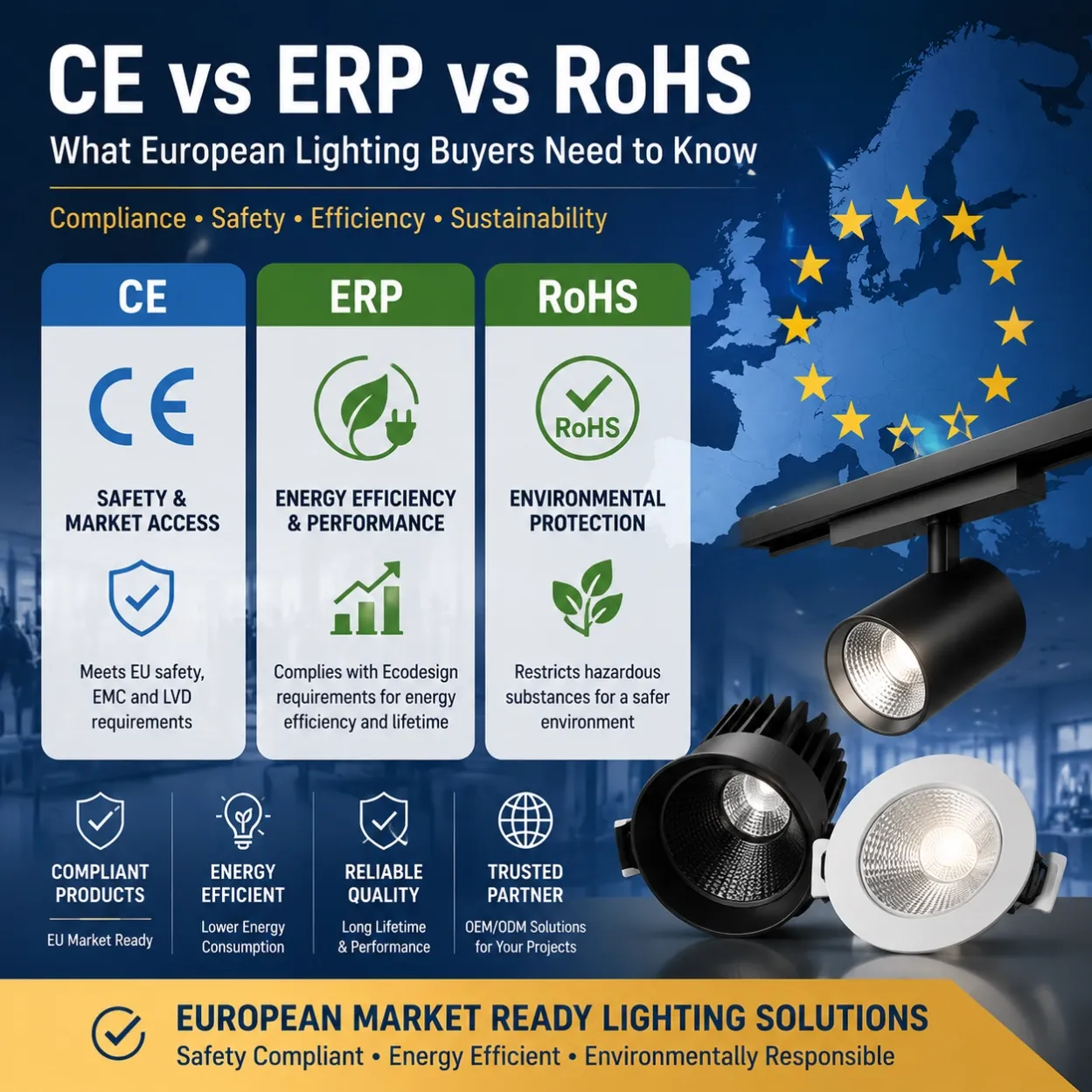
Regulation | Main Purpose | Focus |
|---|---|---|
CE Marking | Product safety and market access | Electrical safety, EMC, health requirements |
ERP (Energy Related Products) | Energy efficiency and sustainability | Energy consumption, performance, lifetime |
RoHS | Environmental protection | Restriction of hazardous substances |
Together, they ensure that LED lighting products placed on the European market meet essential requirements for:
- Safety
- Energy efficiency
- Environmental responsibility
- Product reliability
1. CE Marking: Ensuring Product Safety and Market Access
What Is CE Compliance?
CE marking indicates that a product meets applicable European Union health, safety, and environmental protection requirements.
For LED lighting products, CE compliance mainly covers:
Electrical Safety
Ensuring products operate safely under normal and abnormal conditions.
Examples:
- Protection against electric shock
- Insulation requirements
- Over-temperature protection
Electromagnetic Compatibility (EMC)
LED drivers and electronic components must operate without causing harmful electromagnetic interference.
Testing typically includes:
- EMC emission
- EMC immunity
Low Voltage Safety
Lighting products must comply with relevant electrical safety requirements to ensure safe operation.
How We Support CE Compliance in LED Lighting Development
During product development, we focus on:
Electrical Engineering
Including:
- Driver selection
- Circuit protection
- Safety design
Product Testing
Including:
- Electrical safety testing
- EMC performance verification
- Temperature testing
Component Selection
Using reliable:
- LED modules
- Drivers
- Connectors
- Electrical components
to ensure stable and safe operation.
2. ERP: Improving Energy Efficiency and Product Performance
What Is ERP Regulation?
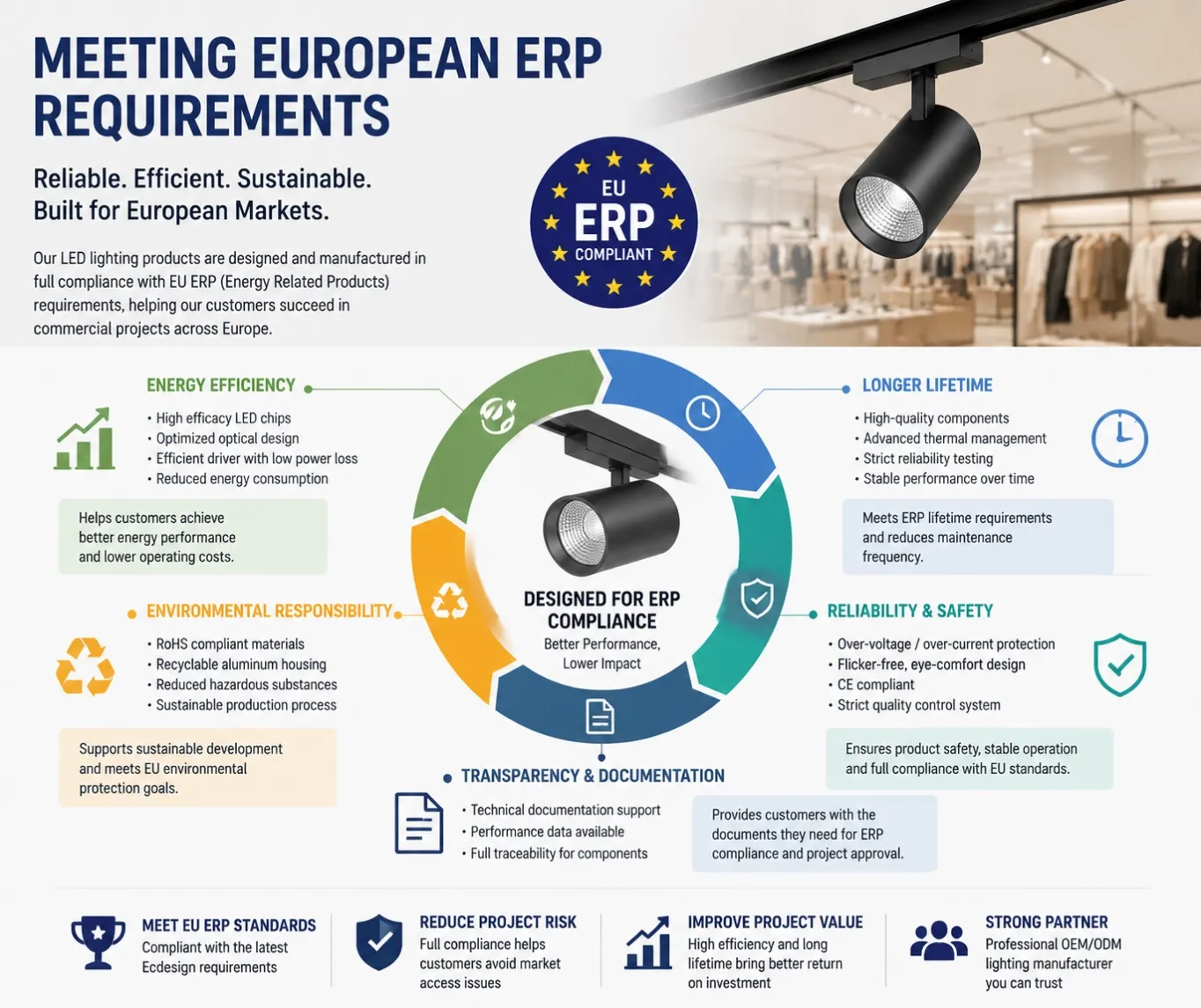
ERP stands for Energy Related Products and is part of the EU Ecodesign framework.
Unlike CE, which focuses mainly on safety, ERP focuses on:
- Energy efficiency
- Product performance
- Lifetime
- Environmental impact
For LED lighting products, ERP requirements encourage manufacturers to develop products with:
- Higher luminous efficacy
- Lower energy consumption
- Longer lifetime
- Better resource efficiency
How Our LED Products Meet ERP Requirements
High-Efficiency LED Technology
We optimize:
- LED selection
- Optical efficiency
- Driver performance
to achieve better lm/W performance.
Advanced Optical Design
A high-quality optical system helps maximize useful light output.
Our engineering process includes:
- Lens optimization
- Reflector selection
- Beam angle control
to reduce optical loss and improve lighting efficiency.
Thermal Management Design
LED lifetime is highly influenced by temperature.
Our thermal engineering includes:
- Heat sink optimization
- Thermal simulation
- Temperature testing
Materials such as:
- 6063 extruded aluminum
- ADC12 die-cast aluminum
are selected according to project requirements.
3. RoHS: Controlling Hazardous Substances
What Is RoHS Compliance?
RoHS stands for:
Restriction of Hazardous Substances
It limits the use of certain harmful materials in electrical and electronic products.
The purpose is to:
- Reduce environmental pollution
- Improve product sustainability
- Protect human health
Restricted substances include:
- Lead (Pb)
- Mercury (Hg)
- Cadmium (Cd)
- Hexavalent Chromium (Cr VI)
- Certain flame retardants
How We Ensure RoHS Compliance
Our supply chain management includes:
Material Control
Selecting:
- RoHS-compliant aluminum materials
- Approved electronic components
- Certified suppliers
Production Control
Monitoring:
- Incoming materials
- Manufacturing processes
- Component traceability
Documentation Support
Providing customers with:
- Material declarations
- Compliance documents
- Technical information
CE vs ERP vs RoHS: Key Differences
Item | CE | ERP | RoHS |
|---|---|---|---|
Main Purpose | Safety approval | Energy efficiency | Environmental protection |
Required For | Market access | Energy-related products | Electronic products |
Main Focus | Electrical & EMC safety | Efficiency & lifetime | Hazardous substances |
Related To | Product operation safety | Energy performance | Material composition |
Applies To LED Lighting | Yes | Yes | Yes |
Why European Lighting Buyers Should Work With a Professional Manufacturer
Compliance is not something added at the end of production. It should be considered from the beginning of product development.
A professional OEM/ODM lighting partner should support:
1. Project Requirement Analysis
Understanding:
- Application environment
- Market requirements
- Certification expectations
- Customer specifications
2. Product Engineering
Including:
- Mechanical design
- Optical design
- Thermal simulation
- Electrical optimization
3. Quality Verification
Including:
- Performance testing
- Reliability testing
- Documentation preparation
Common Mistakes European Buyers Should Avoid
Mistake 1: Assuming CE Means Everything Is Covered
CE confirms compliance with applicable safety requirements, but it does not replace ERP or RoHS obligations.
Mistake 2: Choosing Products Only Based on Price
Low-cost products may have:
- Poor thermal design
- Short lifetime
- Unstable driver performance
- Missing documentation
which can create risks during European projects.
Mistake 3: Ignoring Long-Term Performance
For commercial lighting projects, customers expect:
- Stable lumen output
- Low maintenance costs
- Reliable operation
Compliance and engineering quality directly affect project success.
Our Approach to European Commercial Lighting Projects
As an OEM/ODM commercial lighting manufacturer, we help customers develop products that meet European market expectations through:
✓ Professional optical design
✓ Thermal management optimization
✓ Reliable component selection
✓ Quality manufacturing process
✓ Compliance documentation support
From concept development to mass production, we provide complete lighting solutions for European commercial projects.
Conclusion
CE, ERP, and RoHS represent three important aspects of European lighting compliance:
- CE ensures product safety and market access
- ERP improves energy efficiency and sustainability
- RoHS protects the environment through material control
For European lighting buyers, choosing a manufacturer with strong engineering capability and compliance experience is essential for reducing project risks and delivering reliable commercial lighting solutions.