Jul 23, 2026Blog
How to Reduce Glare in Commercial LED Lighting Design?
Learn how to reduce glare in commercial LED lighting design through optical solutions, reflector selection, beam angle control, and low glare lighting technologies commercial spaces
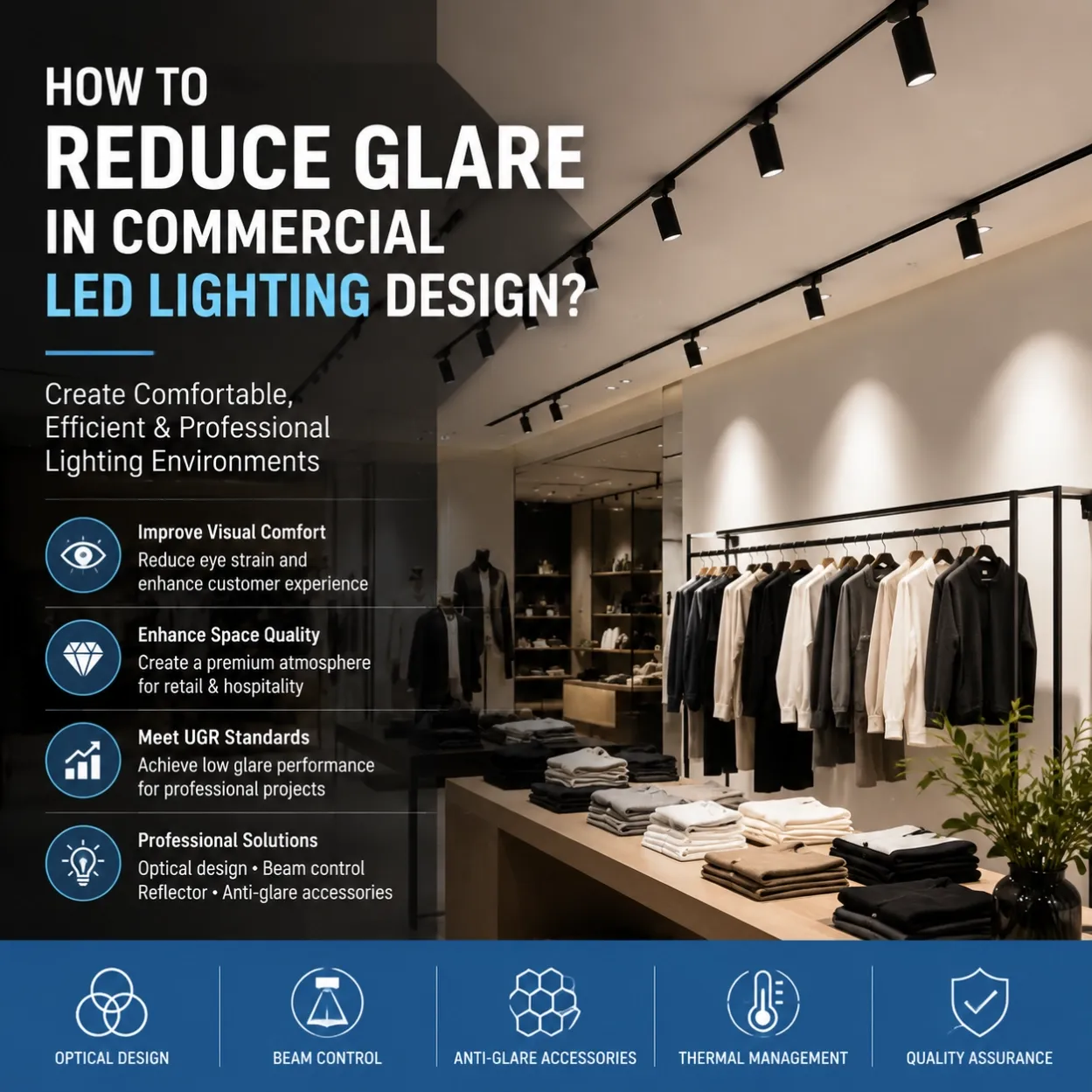
A Complete Guide to Low Glare Solutions for Retail, Office, Hospitality and Architectural Lighting
In commercial lighting design, achieving sufficient brightness is only one part of the solution. Visual comfort, glare control, and lighting quality are equally important factors that determine the overall experience of a space.
Poorly designed LED lighting can create uncomfortable glare, eye fatigue, and an unpleasant environment, even when the illumination level meets project requirements.
For modern commercial spaces such as retail stores, hotels, offices, galleries, and luxury boutiques, low glare lighting design has become a key requirement for professional lighting solutions.
This article explains what causes LED glare and how optical design, reflector selection, beam control, and thermal engineering can help create more comfortable lighting environments.
What Is Glare in LED Lighting?
Glare refers to excessive brightness within a person's field of view that causes discomfort or reduces visibility.
In LED commercial lighting, glare usually occurs when:
- The LED light source is directly visible
- The fixture has excessive luminance
- The beam angle is not suitable for the application
- The reflector or lens design creates concentrated hotspots
Unlike traditional light sources, modern LEDs have extremely high brightness from a very small emitting area, making glare control more challenging.
Why Is Glare Control Important in Commercial Lighting?
A well-designed commercial lighting system should not only illuminate products or spaces but also create a comfortable visual environment.
Effective glare control can:
Improve Customer Experience
In retail environments, excessive glare can distract customers and reduce the visual appeal of merchandise.
Properly controlled lighting helps:
- Highlight products naturally
- Improve shopping comfort
- Create premium brand experiences
Increase Workplace Comfort
In offices and commercial buildings, uncontrolled glare may cause:
- Eye strain
- Visual discomfort
- Reduced productivity
Low glare lighting improves employee comfort and creates healthier working environments.
Enhance Architectural Quality
Hotels, restaurants, museums, and galleries rely heavily on lighting quality.
Controlled brightness and smooth light distribution help create:
- Elegant atmosphere
- Better spatial perception
- Higher design value
Understanding UGR: The Standard for Glare Evaluation
The Unified Glare Rating (UGR) is an internationally recognized method used to evaluate discomfort glare in indoor lighting environments.
The lower the UGR value, the better the glare control.
Common recommendations:
Application | Recommended UGR |
|---|---|
Office lighting | UGR < 19 |
Classroom lighting | UGR < 19 |
Retail stores | UGR < 22 |
Hospitality spaces | UGR < 22 |
General commercial areas | UGR < 25 |
Professional lighting designers consider UGR together with:
- Beam angle
- Installation height
- Fixture position
- Reflector design
- Surface brightness
5 Effective Ways to Reduce Glare in LED Commercial Lighting
1. Use High-Quality Optical Design
The optical system is one of the most important factors affecting glare performance.
A professional LED fixture usually combines:
- LED module
- Secondary lens
- Reflector
- Diffuser or anti-glare accessories
A well-designed optical system controls the direction of light instead of allowing uncontrolled emission.
2. Choose the Right Reflector Technology
Reflector design directly influences glare, beam quality, and visual comfort.
Smooth Spun Reflector
Advantages:
- High optical efficiency
- Strong center intensity
- Cost-effective
Limitations:
- Higher peak brightness
- More visible LED image
- Stronger glare at certain viewing angles
Faceted Reflector (Alanod Reflector)
Advantages:
- Better light mixing
- Reduced LED imaging
- Softer beam transition
- Improved glare control
Faceted reflectors are widely used in:
- Luxury retail lighting
- Museum lighting
- Hospitality projects
- Premium architectural applications
3. Select the Appropriate Beam Angle
Choosing the correct beam angle is essential for glare control.
Narrow Beam (10°–24°)
Suitable for:
- Jewelry display
- Accent lighting
- Artwork illumination
However, narrow beams require careful optical design because they can create higher brightness contrast.
Medium Beam (24°–40°)
Suitable for:
- Fashion stores
- Commercial retail
- Showrooms
Provides a balance between:
- Highlighting products
- Comfortable illumination
Wide Beam (40°–60°)
Suitable for:
- General lighting
- Offices
- Large commercial spaces
Creates softer and more uniform illumination.
4. Use Anti-Glare Accessories
Additional glare-control components can significantly improve visual comfort.
Common solutions include:
Honeycomb Louvers
Benefits:
- Reduce direct view of LED source
- Control high-angle light
- Improve visual comfort
Deep Reflector Design
A deeper reflector position can:
- Hide the LED source
- Reduce direct brightness
- Improve glare performance
Recessed Optical Structure
By placing the light source deeper inside the housing:
- The viewing angle becomes more comfortable
- Direct glare is minimized
5. Optimize Thermal Management
Although glare is mainly an optical issue, thermal design also affects long-term lighting quality.
Poor heat dissipation can cause:
- Higher LED temperature
- Faster lumen depreciation
- Color shift over time
Professional commercial lighting fixtures require:
- Proper aluminum housing design
- Thermal simulation analysis
- Temperature testing
Materials such as:
- 6063 extruded aluminum
- ADC12 die-cast aluminum
are selected based on different performance requirements.
Lens vs Reflector: Which Provides Better Glare Control?
Feature | Lens System | Reflector System |
|---|---|---|
Beam control | Excellent | Excellent |
Efficiency | High | High |
LED image control | Good | Depends on design |
Glare control | Good | Excellent with faceted reflector |
Application flexibility | High | High |
The best solution depends on:
- Project requirements
- Lighting effect
- Installation environment
- Budget
In premium commercial lighting, many manufacturers combine precision lenses with advanced reflectors to achieve optimal performance.
Low Glare Lighting Applications
Retail Stores
Requirements:
- Comfortable shopping environment
- Accurate product highlighting
- Premium visual experience
Recommended:
- Low glare track lights
- Faceted reflectors
- CRI 90+ LED modules
Hotels and Hospitality
Requirements:
- Relaxing atmosphere
- Soft illumination
- Architectural integration
Recommended:
- Recessed downlights
- Adjustable spotlights
- Controlled beam distribution
Museums and Galleries
Requirements:
- Precise lighting control
- Minimal visual distraction
Recommended:
- High-quality optical systems
- Low glare spotlights
- Narrow beam solutions
How We Approach Glare Control in Custom Lighting Development
At the product development stage, glare performance should be considered from the beginning.
Our engineering process includes:
- Project Requirement Analysis
- Optical System Selection
- Beam Angle Simulation
- Reflector and Lens Optimization
- Thermal Simulation
- Prototype Testing
- Final Performance Verification
By combining optical engineering, thermal management, and manufacturing expertise, customized commercial lighting fixtures can achieve both high efficiency and excellent visual comfort.
Conclusion
Reducing glare in commercial LED lighting requires more than simply lowering brightness. It requires a complete approach involving:
- Optical design
- Reflector selection
- Beam angle optimization
- Anti-glare structures
- Thermal management
For modern commercial spaces, the goal is not only to provide enough light but to create comfortable, efficient, and visually attractive lighting environments.
A well-designed low glare LED lighting system enhances customer experience, improves workplace comfort, and adds greater value to architectural spaces.